
No, EtherCAT is not a new kind of feline breed! It is actually a Fieldbus communication standard  that is used for interconnecting devices in the control and automation arena.
EtherCAT stands for Ethernet for Control Automation Technology and was originally developed by Beckoff Automation.
As of 2007, EtherCAT has been included as a Fieldbus standard of IEC 61158 and 61784-2.
How does it work?
EtherCAT is well known for its network speed. The fundamental principle  of EtherCAT is called pass-through reading. Imagine a metro train network where each passenger can disembark/ embark while the train continues to move through the stations. In EtherCAT, the train represents the message transmitted by the Master, the stations are the slave nodes, and the passengers are the data the message is carrying. As the message passes through each node, the node reads its inputs (data) and adds its outputs to the message. When the message reaches the Master, every node in the network has received new input data from the Master and returned a new output data to the Master. With this principle in mind, an EtherCAT network can reach maximum bandwidth utilisation because it only has to transmit a message once, which can cater to all of the nodes in the network.
What are its benefits?
- Fast Speed – because of the “processing on the fly” as explained above, the process is so much quicker than a standard Ethernet network. Delays caused by stopping and restarting are avoided. Master devices simply issue the message and receive the response. Single message in – single message out.
- Flexible Topology – EtherCAT networks can support many types of topology. Akin to standard Ethernet, you can use Star, bus/trunk, ring or combinations of different topologies.
- There is practically no limit to the number of slave nodes, unlike other Fieldbus technologies. 65535 nodes to be exact!
- Cable redundancy – like the metro train that can run in reverse, the message can also be transmitted in reverse. Even if there is a line break between slave nodes, the message can still reach the other node in a ring network topology via the reverse path.
- Synchronisation – an EtherCAT network includes a distributed clock mechanism that reduces jitter to a low level without the need for additional hardware. As the message is passed through each node, the slave node adds timestamps to the EtherCAT frame twice (one for receiving and the other as the message leaves the node). All this information that is added to the frame will reach the Master, and the Master can then calculate the delay for each node to adjust accordingly.
A Practical Application
Mescon had a project that required control of a materials handling system, aka conveyor system. (https://www.youtube.com/watch?v=iuKX7s7mO7E&feature=youtu.be). The system was divided into six 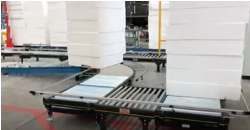 sections, which were further divided into 3-4 zones. The zones were controlled by an Interroll drive controller. It controlled the roller drives and monitored materials that passed through the zones using laser prox switches. Although the Interroll controller’s CPU controlled each zone, the brains of the system was an Omron NX1P2 PLC. The central PLC talked to each of the Interroll drive controllers via EtherCAT. The information from the prox sensors was passed through the Interroll drive controller, which was the PLC then read. Logic functions were handled in the PLC and then sent the command via the Interroll drive controller to start or stop the roller drives and lifting table in a controlled manner.