
Will IoT kill SCADA?
For over 40 years,  SCADA has been the backbone of driving operational improvements, helping to reduce costs and boost the efficiency of production processes. Although still a key component to production management and improvement, is SCADA at risk of becoming the forgotten cousin?
Today it is seemingly unlikely that you will have a conversation about production management and improvement without talking about IoT. This pillar of the fourth Industrial Revolution (Industry 4.0) is perhaps the most over-talked, least understood advance in technology that seems to have eclipsed everything else before it. But will it signal the death of SCADA?
What is SCADA?
Simply put, SCADA (Supervisory Control and Data Acquisition) is the software and hardware that provides a solution for monitoring and controlling a system and the associated processes while also gathering and processing data on a real-time basis, either locally or remotely. Interaction with the SCADA can be via an HMI (Human Machine Interface), computer or smart device.
SCADA is not a full-control system, but rather a computer system that gathers and analyses real-time data. It is useful for monitoring and controlling equipment, gathering information about a mishap and sending an alert, as well as carrying out the necessary analysis and control to then display information in an organised and logical way for humans to interpret and use accordingly.
SCADA systems still predominate across most industries. However, having grown through three generations of application –  standalone, distributed and networked, some have suggested that the next generation is here now, IoT – that shiny new technology that is developing faster than anything we have seen in recent years. With the rapid take-off of Industry 4.0, it could be said that we are seeing the fourth generation of SCADA, aka IoT.
Is IoT the perfect partner, perhaps?
IoT is a network of physical devices connected via electronic embedding,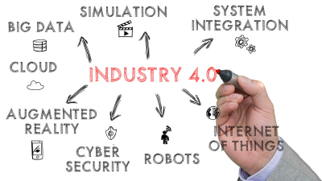 software setups, sensor-actuators and network connectivity which all act together for the objects to connect and exchange data. IoT allows objects to be sensed or controlled remotely across different networking infrastructures. In turn, this creates opportunities for more integration of the physical world into the computer system of which SCADA is a part. It may result in improved efficiency, accuracy and economic benefit. It may reduce human intervention and operator mistakes.
IoT technology brings many desirable attributes, including ease of installation, reduced cost, increased data access and accuracy, as well as remote control and monitoring. It gives access to production data to those who have never had access. However, compared with SCADA, IoT is still relatively new, with unregulated technology and no standards. SCADA can be very relevant in Industry 4.0. It is not a question of whether to have IoT over SCADA, but rather how to employ SCADA within IoT. Many IT specialists consider IoT has helped to revolutionise SCADA through increased standardisation and openness, providing scalability, inter-operability and improved security through the concept of the IoT platform. The truth is that they have been able to apply principles that they are familiar with, some of which are better, but some of which introduce vulnerability.
In this new paradigm, IoT begins where SCADA ends. 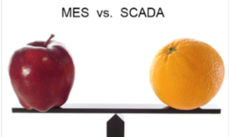 SCADA’s role is more at the line level. Its role is to monitor and control, whereas IoT’s focus is analysing data to improve productivity and impact your top line. At Mescon we still call this MES, and our engineers have been involved in many successful systems since pre Y2K. This aspect of IoT is not new; it is the cheap technology that is new. IoT is essentially the culmination of advances in the connectivity of hardware and data networks along with cloud computing and data processing.
Assimilate or Assassinate?
IoT is bringing about a new wave of business models and technologies that are changing the landscape of SCADA. While the IoT market is still young, it can co-exist with SCADA. That said, the SCADA platform has lacked innovation, a fact borne out by IoT concepts and solutions being integrated into SCADA architecture. If these two technologies can avoid fighting each other, and learn to integrate, they will push the industry forward.
SCADA is typically limited to the factory floor –  data collected from devices are only being viewed inside the plant. IoT, however, takes the same data, along with other data, and offers insight to the user and makes it available anywhere, anytime. Some may not want this openness for very valid reasons, but the data enables new business models to be created. It is becoming cheaper to collect data, to create a wide range of reports such as OEE, production data reports and utility reports (gas, water, electricity).
Both SCADA and IoT involve sensors and data acquisition. Despite differing in many aspects, they both share the one common goal – the optimisation of and better control over devices and/or processes. The concept of the smart grid (where our electricity is de-centralised and normalised) is just one example that points to SCADA and IoT integration.
Mescon have been taking production data and correlating it with other data for years. Therefore, if you are considering the advantages of IoT but want to avoid the disadvantages, such as bad data, cost blowout, too simple (aka useless), robustness, safety, and cybersecurity, we suggest you talk to us first and reduce the risks involved in implementing IoT.