
“Time is the longest distance between two places.” (by famous American playwright Tennessee Williams.) As we all know, time is a precious  commodity that everyone seems to run out of due to our hectic lives. Especially if you need to be at different places at the same time. Thanks to advancements in digital technology, distance is no longer an issue. The same can be said in the industrial arena, where sites may have multiple locations. Nowadays, it is possible to monitor and control your assets even when you are not physically there. From anywhere in the world, with a flick of your mobile device, you’ll be able to gain remote access to your operation in no time.
What comprises a remote monitoring system?
Remote monitoring is now becoming a common feature of automated equipment as part of the implementation of the Industrial Internet of Things (IIoT). Remote monitoring connections to machines and processes are now easier and more price-competitive thanks to the use of these maturing technologies. These remote connections are usually made to Programmable Logic Controllers (PLCs) and Human-Machine Interfaces (HMIs) via internal intranets or the web, often using a virtual private network (VPN) router or direct connection to the cloud. On the other end of the remote connections are your everyday devices, such as PCs, smartphones and tablets.
Why is it important?
There are several reasons why remote monitoring is important. Regardless  of what you operate, understanding when and why a problem occurs gives you new insight, which often leads to improvements and better decision-making. Remote monitoring for industrial automation helps manufacturers or asset owners to reduce their overall costs by minimising downtime, improving productivity and streamlining maintenance.
A practical application
Mescon, in collaboration with ECM, has designed and created a remote monitoring system that is used in the crane industry. The system’s purpose is to monitor and record vital information related to actions of the crane operator, such as over-jogging, e-stops, motor overload and other fault conditions.
The system configuration is as follows:
- An M241 Schneider PLC talks to a wireless crane
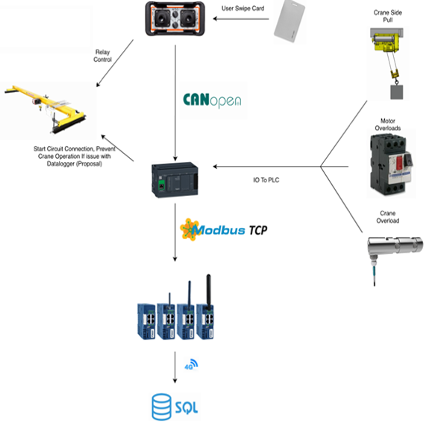 remote control via CANopen.
 - The PLC monitors crane signals, e.g. crane overload, motor overload and side pull.
- Card data from the user swipe card is also recorded via the crane remote control.
- The PLC publishes the tags using Modbus TCP to an EWON Flexy 205.
- The Ewon is a VPN router. It logs data using 4G to the cloud.
- Logged data generated by the tags is stored in a MySQL database using an API.
- A web app accesses this data for representation and monitoring.
- An M241 Schneider PLC talks to a wireless crane
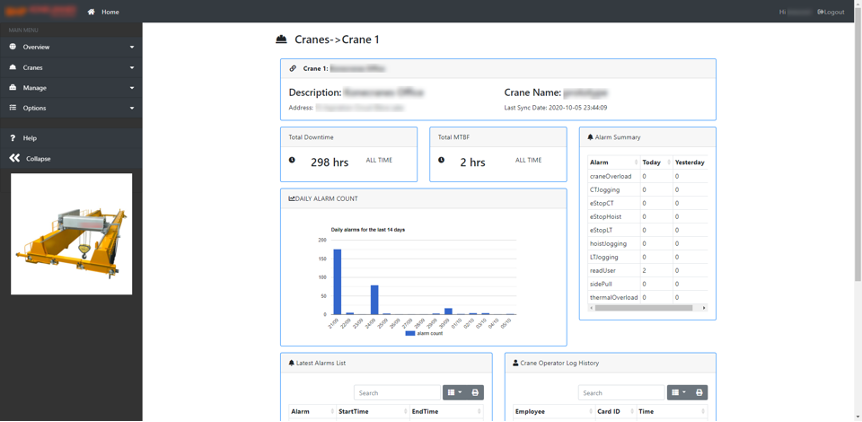
The asset owners can monitor the daily operation of their cranes, which gives them insight as to what is happening to their equipment in almost real-time. Equipped with new insights, the asset owners can swiftly react to problems as they arise, or even before they become a real issue, because the information is already available without them even leaving the comfort of their office or home. This saves them valuable time and money that can be redirected to where it is needed the most.