
The pandemic pressure to do the same, if not more, with less.
Most people in business have experienced highs and lows, which may be referred to as cycles. However, no matter how experienced you are, very few could have seen or understood the impact that COVID-19 would have on their business. Some have been able to rise and pivot to the challenges and new opportunities presented, but unfortunately, others have not. No matter where a business is at, perhaps a universal challenge for everyone now is, how to do the same with less.
Social distancing and ensuring a safe work environment have meant that manufacturing, in many cases, is now undertaken with less people on the floor. This means less eyes to observe and analyse what is happening, less on-site experience to foresee and respond proactively, and less manpower to respond optimally to failures and breakdowns.
With no foreseeable relief from the impediment of COVID, 
many may be wondering how to manage long-term with fewer people on the factory floor – to know what is happening where and what to do. If you are not a high-tech manufacturing facility, then it is highly likely that your plant floor has older automation systems, maybe with a couple of newer PLCs, maybe some stand-alone CNC controlled machines and perhaps even manually operated equipment. Perhaps you already have limited monitoring but need to ‘see’ all that is going on in an effective and timely manner, and the idea of connecting stand-alone equipment to a monitoring system, e.g. SCADA, seems too complicated and expensive.
In the past, if you wanted real-time data from a non-PLC controlled machine (e.g. a relay-controlled machine), you would have had the expense of upgrading the controller and probably also installing a network. This was often cost-prohibitive. Now with declining costs, flexible technologies and ease of installation, applying an Industrial IoT (IIoT) solution to increase your visibility need not be so challenging or daunting. IIoT has the power to transform operations, give key insights into performance and quality, as well as automate and optimise processes once considered inconceivable. Even if you already have a high degree of ‘visibility’ and meaningful real-time data, your challenge might be how to monitor specific processes that, pre-COVID, would have been performed by staff on the floor.
The practice of IIoT (Industrial Internet of Things) is not new to the factory floor, but newer technologies offer a different pathway to IIoT and make it an extremely viable option. These technologies include:
Smart Sensors. These are not as fully featured as a plant-wide IIoT architecture, but they offer a low-cost alternative to gathering data from a single process. Dedicated to monitoring specific tasks such as count, position, watch (activity), and measure, smart sensors capture and send data to on-site or cloud-based data servers via edge devices (aka edge gateways) and give you real-time insights. Equipped with mesh networks, these devices operate over Wi-Fi, independent of any other network.
Edge gateways. If a factory has legacy equipment that was developed pre-internet (thus pre-IoT), there would be little or no connectivity to that machine. Extracting data from such a machine in a timely manner and storing it in a database or historian would be near impossible. However, intelligent gateways are now bridging such legacy systems via network solutions that make it possible to collect and send key data from such machines. Vendors are striving to make edge hardware and IoT systems easier to configure and use, with some vendors offering turnkey solutions that include hardware, software, and a data collection platform.
Video Cameras. Video technology, perhaps better known as ‘machine vision’, is at a feasible price point with increasingly higher resolution cameras released at lower costs and with increased functionality. Used in various ways, machine vision performs tasks such as detecting colours, locating edges and/or key features, testing component orientation, measuring, and checking quality aspects. Capturing critical information via video at the device level is a big step forward to knowing in real-time if anything is out of the ordinary. It is a viable alternative when it is no longer possible to have the same number of people on the production floor due to COVID safety requirements.
TrakSYS.
An edge solution that Mescon offers is the TrakSYS IIoT smart data collection system. 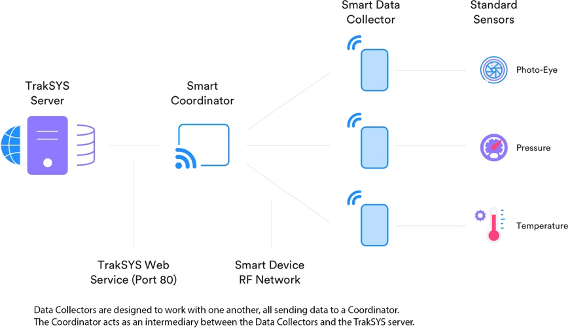 TrakSYS includes IIoT data collectors and a coordinator, as well as auto-configuration software, which makes it as easy as possible, in virtually any environment and regardless of existing infrastructure, to set up and manage manufacturing operations management solutions built using the proven TrakSYS platform.
The TrakSYS Smart Coordinator is an edge device that aggregates data from smart data collectors and shares that input with a TrakSYS server – on-premises or in the cloud. Configuration is done through a web-based interface that allows users to set up and monitor the coordinator, individual data collectors, and the system’s connection to TrakSYS.
TrakSYS is an integrated platform that can power multiple solutions. The modular nature of TrakSYS brings complete flexibility to deploy only the functions desired, without a software upgrade required. TrakSYS business solutions include MES/MOM, OEE, SPC, e-records, maintenance, traceability, workflow, batch processing, sustainability, labour, and more.
Speak to us today to find out more about how implementing a TrakSYS solution can benefit your business. For more information, click this link.